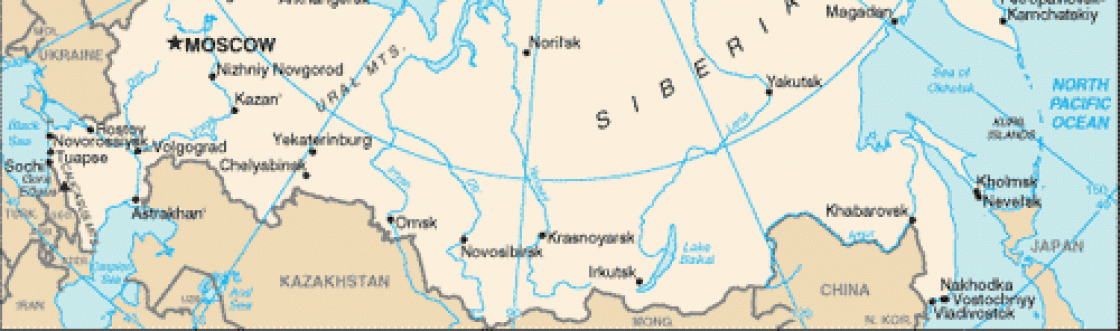
Last Thursday, October 9th, former President of Latvia Vaira Vike-Freiberga spoke at the Commonwealth Club in San Francisco. Discussion focused on Eastern European security in light of the recent conflict between Ukraine and Russia, and the “flammable” relationship between Russia and the states which once made up the Soviet Union. Dr. Vike-Freiberga, President of Latvia from 1999-2007, now leads the World Leadership Alliance-Club de Madrid, a forum where democratic former presidents and prime ministers lend their expertise to foster democratic development around the world. During her time in office she oversaw the country’s admittance into the European Union, the North Atlantic Treaty Organization, and signed a treaty with Russia which formally recognized Latvia’s sovereign borders.
Dr. Vike-Freiberga, whose family fled Latvia during the Russian occupation in 1945, lived as a refugee in Germany and Morocco before settling in Montreal, Canada. She received her doctorate in experimental psychology from McGill University and had a successful career in their Department of Psychology before moving back to Latvia in 1998. She became the Director of the Latvian Institute, which worked to promote Latvian identity abroad, and was elected as the country’s President one year later. Dr. Viki-Freiberga divulged she never felt fully accepted as Canadian, and as a result was “active in Latvian affiliations” and communities throughout her adult life.
True to her first profession as a psychologist, Dr. Vike-Freiberga began her discussion at the Commonwealth Club on the concept of language and reality, stating “the way people label things influence their actions.” She visited the idea that Russia has a “sphere of influence,” in which it acts on its interests despite, and often at the expense, of its neighbors. Dr. Vike-Freiberga said this is an idea the United States may relate to or “think fondly of” when considering its own sphere of influence, but to Latvians and “those who have the misfortune of being next to [Russia],” this idea is terrifying and threatens the integrity of their sovereignty. She spoke of the frustration Latvians feel when foreigners have trouble distinguishing their country from Russia and the Soviet Union, or feel it is “natural” for Russia to act as if they still rule these countries.
Indeed, Russia has seen it in its best interest to violate its neighbor’s sovereign territory, and has used double-speak as one of its strongest weapons. During its invasion of the Crimean Peninsula in southern Ukraine and the on-going war surrounding Donetsk and Luhansk in the east, Russia has continually said that it has no military personnel in these locations. It continually alleges that the fighters are “local self-defense forces,” despite obvious clues they are Russian forces. The Kremlin says any Russian personnel fighting there are doing so while on a vacation, and at times claims ridiculous notions like “the paratroopers crossed into Ukraine by accident,” or that Russian military actions are simply part of a “humanitarian mission”. While this farce may or may not affect the political actions of other countries, it certainly affects public opinion.
When asked if she thought the United States was doing enough to help Ukraine, Dr. Vike-Freiberga first thanked the United States for the public statements its leaders have made in “not accepting as legitimate the annexation” of Crimea, citing this as “extremely important.” She then stressed she would “encourage [the United States] to take measures to help Ukraine fight for sovereignty.” The United States, she reminded us, was one of three guarantors, including Great Britain and Russia, in the Budapest Memorandum of 1994. This is the event in which Ukraine gave up their stockpile of nuclear weapons to Russia in return for respect of its sovereignty and territorial integrity. Dr. Vike-Freiberga insists the Budapest Memorandum “left [Ukraine] wide open to invasion, annexation, and the gradual tearing asunder of its independence,” and asked that the United States “reflect on that responsibility” when considering its support of Ukraine in its current conflict.
“It’s a pity [that] in 2008… Georgia and Ukraine were refused from NATO,” she adds, saying she feels this “gave the go-ahead to Russia” to encroach upon their borders. Dr. Vike-Freiberga declared that Latvia’s “efforts to join NATO keep [them] safe from any direct threats. If not,” she said, “my country would be in more serious danger.” Despite their inaction in the Ukraine-Russia conflict, the United States has reiterated its support of countries within the organization. NATO has also reaffirmed its commitment to defending its member states. It recently delivered paratroopers, equipment, vehicles and aircraft to Latvia, where military exercises are taking place. NATO fears Russia may use the same rationale for invading Crimea to provoke Latvia or other Baltic States, which have Russian-speaking populations.
The economic relationships between Russia and former Soviet states make these military conflicts increasingly sensitive. “During the Soviet Union, there was economic interdependence,” explained Dr. Vike-Freiberga. “The hope was to keep the empire from collapsing.” Indeed, “there was a crisis when it collapsed.” She said Latvia has come a long way since those times, and that right now “80% of all trade is with other countries” besides Russia. However, Latvia’s gas supply is still “totally dependent on Russia,” a weakness it shares with many other European nations, including Ukraine. This gas supply enables people to survive through the winter months, a fact that looms darkly over the political decisions in the region. Dr. Vike-Freiberga admits Latvia needs to diversify their gas supply as quickly as possible, adding wryly that “when the United States can make liquid gas… and send it far away to Europe… I would be very happy.”
 Post Soviet Security