Economic and human development data can give targeted insight into social phenomena, but can it consistently predict a population’s future behavior? Research suggests that societies with high levels of youth unemployment, inflation and pronounced income inequality are ripe for political violence and mass protest. By observing data patterns between Egypt and Ukraine, both which recently had government coupes following mass public demonstrations, perhaps we can target similarities and identify countries at risk for violent regime change.
The Egyptian Revolution of 2011 is a phenomenon that has been explained in part by factors like high youth unemployment, a pronounced income gap and an increasingly unmanageable cost of living. It’s true that while unemployment in 2010 was at a moderate level by Egyptian standards, about 9% of the total work force, youth unemployment was over 25% between the ages of fifteen and twenty-four. What’s more, Egypt is experiencing a youth bulge, with half of the population in 2010 under the age of twenty-five and 20% of the population between ages fifteen to twenty-four. Based on population of Cairo in 2011, which was about 11,160,000 people, the 15 to 24 year old demographic would have totaled more than 2.2 million at the time of the revolution, and over 558,000 of them would have been unemployed.
Looking purely at data regarding overall economic growth, it would be easy to think that the majority of Egypt’s population was doing rather well leading up to the revolution. A closer look shows signs of stress. Between 2005 and 2010, the country’s GDP growth had been fluctuating between a robust 4-7%, and total GDP had risen to over $200 billion in current USD. However, the distribution of income across the population is concentrated largely within the wealthiest 10%. In 2005, the wealthiest 10% of the population shared over 27% of all income, while the poorest 10% held below 4%. This signifies that the majority of economic growth would have been felt primarily by the wealthy. The percentile distribution across each quintile of the income spectrum, from wealthiest quintile of the population to the poorest, was 41%, 21%, 16%, 13%, 9%, respectively.
To exacerbate the income gap even further, the price of consumer goods had been steadily increasing over the decade prior to the Egyptian Revolution, putting even more of a burden on those towards the bottom of the income spectrum. Since 2001, inflation had risen from a reasonable 2.3% to a concerning 11.3%. Coupled with a high youth unemployment rate, the environment was rife with dissatisfaction and vulnerable to political upheaval.
The Ukrainian Revolution of 2014 provides an intriguing comparison against Egypt’s revolution and corresponding statistics. To start, while Ukraine’s total unemployment rate in 2013 was slightly lower than Egypt’s in 2010, their youth unemployment rate was significantly lower. The unemployment rate for the total workforce was 7.9%, yet unemployment for the youth demographic, fifteen to twenty-four years old, was 17.8%. This is relatively high, but is just half of what Egypt’s had been on the eve of their recent revolution.
Ukraine is also not experiencing the same youth bulge as Egypt, and therefore did not have a disproportionate or overwhelming number of unemployed youth. In 2013, people ages fifteen to twenty-four made up about 12.6% of the population in Ukraine, almost half compared to the same age demographic in Egypt. Using estimates of Kiev’s population in 2013, this puts about 353,000 fifteen to twenty-four year olds in Kiev during the revolution, and about 63,000 unemployed among them. While tens of thousands of unemployed youth is still a large and unruly mob when mobilized correctly, it’s not even close the estimated 750,000 unemployed youth present in Cairo during the Egyptian Revolution.
While Ukraine’s unemployed youth demographic was not as significant as Egypt’s leading up to revolution, its income distribution was similar, albeit slightly more even. In 2010, the wealthiest 10% of Ukraine’s population shared about 21% of all income, while the poorest 10% shared 4%. The percentile distribution of income, from wealthiest quintile of the population to the poorest, was 35%, 22%, 18%, 14%, 10%, respectively.
Unlike Egypt, Ukraine did not have rising inflation in the years leading up to their revolution, and actually had falling inflation, down to 0% in 2013. However, the ten years prior had sporadic leaps and falls in inflation, ranging from 5% to 25%. While this is significantly different than the Egyptian experience, dramatically fluctuating inflation would still have put strain on the majority of Ukrainians. Instability in the price of basic goods can be disastrous for small businesses and low or middle income families, and instill doubt in a government’s ability to shield citizens from the downfall.
GDP growth for Ukraine had also been unpredictable in the decade leading up to 2013. Growth at times was at a strong 12%, like in 2004, and other times a frightening -15%, like in 2009 after the global financial crisis. GDP growth was at a modest 2% in 2013 and total GDP in current USD was more than $183 billion, but the other factors tell us that the economy was not altogether healthy. Sporadic economic growth, inflation and the income inequality in Ukraine would certainly indicate widespread financial stress and an environment of social and political frustration, yet the data is not consistent with the factors present before Egypt’s revolution.
While income distribution was a relatively common factor between Egypt and Ukraine in the years leading up to each government coupe, it is not necessarily the conclusive symptom of a revolution-ready society. If pronounced income inequality is the strongest cause of government destabilization, then the United States would be at greater risk now for revolution than Egypt was in 2011. The percentile distribution of income in the United States, from the wealthiest quintile to the poorest, is 51%, 23%, 14%, 8%, 3%, as of its 2014 census. While the Occupy Wall Street protests in 2011 caused widespread debate about income inequality, it was nowhere near a threat to the current political or economic system.
Following the same logic, Haiti would be at an even higher risk of destabilization and political violence than the United States, based on their income distribution of 64%, 18%, 10%, 5% and 2%, from wealthiest to poorest quintile of the population. Yet even after a disastrous earthquake in 2010, and despite a notoriously corrupt government and over 20% of its population living in extreme poverty, there has been no violent overthrow. There was, however, a political shift within the government immediately after a week of food riots in 2008, which resulted in a new prime minister.
Income distribution isn’t an all-telling metric, and can in some circumstances can be the wrong data point to observe when predicting a society’s political stability. Recent analysis has identified surging food prices as a stronger indicator of widespread public dissatisfaction and riots than less targeted macroeconomic statistics like GDP growth or income distribution. Between 2006 and 2008, the world experienced dramatic inflation in food prices due to factors including drought and rising oil prices, which hit developing economies particularly hard. Developing countries have larger portions of their population living in poverty, meaning a much larger part of their income will be spent on subsistence, oftentimes upwards of 50%. Compounded with inflation, this threat to survival effectively mobilizes the masses, regardless of political affiliation.
Despite that Egypt is a net importer of food and Ukraine is a net exporter, both countries had high political tension from 2006 onwards as a direct result of food inflation. Food prices have also been linked to riots in other countries, from Bangladesh to Mozambique. Fourteen different African nations had food protests between 2007 and 2008, with prices increasing more than 100% in some. Many times, food prices are not the sole reason for protest, but rather a strong factor that in conjunction with others fuels such massive demonstrations.
While it’s important to look at macroeconomic data, economic reasons for revolutions are almost always intertwined with other social and political factors. For example, on the one hand corrupt government institutions and lack of economic reform were cited years before the Egyptian Revolution as major threats to the country’s prosperity. On the other hand, sociopolitical ideas of power structures, opportunity and oppression were major issues leveraged by Egypt’s largely young and educated masses during the Revolution, organized by social media and supporting technology.
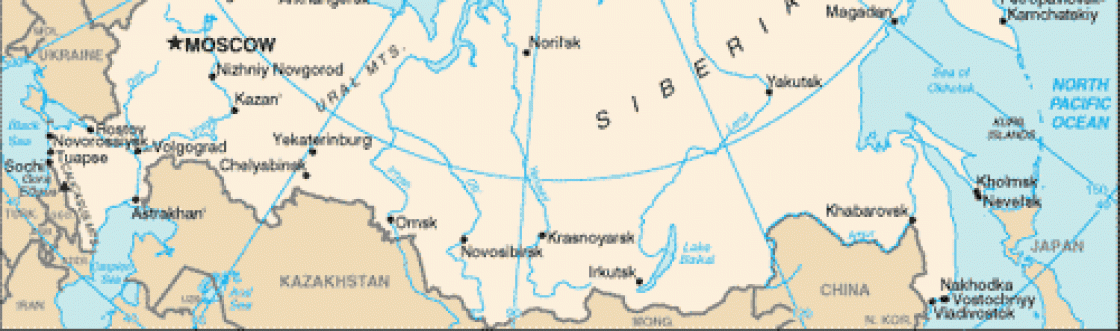
Similarly, while Ukraine’s protests were sparked by President Yanukovych’s rejection of a trade deal with the European Union in favor of one with Russia, the struggle is representative of a broader competition between the interests of Russia and the European Union. Without an ally in power in Ukraine, Russia seized its military and economic assets in Crimea and the eastern provinces of Donetsk and Luhansk, with the political facade of protection for Russian-speaking populations. Ukraine is largely multi-lingual, and has ethnic Russians in all parts of the country, like most ex-Soviet states. Yet, the eastern regions are also the most heavily industrialized, are home to many factories built by the Soviet Union and still export many of their goods to Russia.
So while economics are an essential part of any analysis involving mass social unrest, local historical context is crucial when weighing elements that tip the scale from peaceful protests to violent government overthrow. Political ideas or special interests played a heavy role in the events of both Egypt and Ukraine’s recent revolutions. These types of issues don’t always have elegant, simple statistical models that give clear predictability, but should be considered in conjunction with economic data to forecast social and political instability.
Based on the economic data we observed relevant to Egypt’s Revolution, including information about youth unemployment, inflation and income inequality, we could identify signs of stress in Ukraine but could not have predicted its subsequent Revolution. The economic basis for one country’s political violence may be a survivable reality for another, depending on other social and historical factors. Outside interests or complex internal pressures may usurp an otherwise manageable situation and result in violent regime change.
 Post Soviet Security