Revolutionary Data – Comparing Social Unrest in Egypt and Ukraine

Economic and human development data can give targeted insight into social phenomena, but can it consistently predict a population’s future behavior? Research suggests that societies with high levels of youth unemployment, inflation and pronounced income inequality are ripe for political violence and mass protest. By observing data patterns between Egypt and Ukraine, both which recently had government coupes following mass public demonstrations, perhaps we can target similarities and identify countries at risk for violent regime change.

The Egyptian Revolution of 2011 is a phenomenon that has been explained in part by factors like high youth unemployment, a pronounced income gap and an increasingly unmanageable cost of living. It’s true that while unemployment in 2010 was at a moderate level by Egyptian standards, about 9% of the total work force, youth unemployment was over 25% between the ages of fifteen and twenty-four. What’s more, Egypt is experiencing a youth bulge, with half of the population in 2010 under the age of twenty-five and 20% of the population between ages fifteen to twenty-four. Based on population of Cairo in 2011, which was about 11,160,000 people, the 15 to 24 year old demographic would have totaled more than 2.2 million at the time of the revolution, and over 558,000 of them would have been unemployed.

Looking purely at data regarding overall economic growth, it would be easy to think that the majority of Egypt’s population was doing rather well leading up to the revolution. A closer look shows signs of stress. Between 2005 and 2010, the country’s GDP growth had been fluctuating between a robust 4-7%, and total GDP had risen to over $200 billion in current USD. However, the distribution of income across the population is concentrated largely within the wealthiest 10%. In 2005, the wealthiest 10% of the population shared over 27% of all income, while the poorest 10% held below 4%. This signifies that the majority of economic growth would have been felt primarily by the wealthy. The percentile distribution across each quintile of the income spectrum, from wealthiest quintile of the population to the poorest, was 41%, 21%, 16%, 13%, 9%, respectively.  

To exacerbate the income gap even further, the price of consumer goods had been steadily increasing over the decade prior to the Egyptian Revolution, putting even more of a burden on those towards the bottom of the income spectrum. Since 2001, inflation had risen from a reasonable 2.3% to a concerning 11.3%. Coupled with a high youth unemployment rate, the environment was rife with dissatisfaction and vulnerable to political upheaval.

The Ukrainian Revolution of 2014 provides an intriguing comparison against Egypt’s revolution and corresponding statistics. To start, while Ukraine’s total unemployment rate in 2013 was slightly lower than Egypt’s in 2010, their youth unemployment rate was significantly lower. The unemployment rate for the total workforce was 7.9%, yet unemployment for the youth demographic, fifteen to twenty-four years old, was 17.8%. This is relatively high, but is just half of what Egypt’s had been on the eve of their recent revolution.

Ukraine is also not experiencing the same youth bulge as Egypt, and therefore did not have a disproportionate or overwhelming number of unemployed youth. In 2013, people ages fifteen to twenty-four made up about 12.6% of the population in Ukraine, almost half compared to the same age demographic in Egypt. Using estimates of Kiev’s population in 2013, this puts about 353,000 fifteen to twenty-four year olds in Kiev during the revolution, and about 63,000 unemployed among them. While tens of thousands of unemployed youth is still a large and unruly mob when mobilized correctly, it’s not even close the estimated 750,000 unemployed youth present in Cairo during the Egyptian Revolution.

While Ukraine’s unemployed youth demographic was not as significant as Egypt’s leading up to revolution, its income distribution was similar, albeit slightly more even. In 2010, the wealthiest 10% of Ukraine’s population shared about 21% of all income, while the poorest 10% shared 4%. The percentile distribution of income, from wealthiest quintile of the population to the poorest, was 35%, 22%, 18%, 14%, 10%, respectively.

Unlike Egypt, Ukraine did not have rising inflation in the years leading up to their revolution, and actually had falling inflation, down to 0% in 2013. However, the ten years prior had sporadic leaps and falls in inflation, ranging from 5% to 25%. While this is significantly different than the Egyptian experience, dramatically fluctuating inflation would still have put strain on the majority of Ukrainians. Instability in the price of basic goods can be disastrous for small businesses and low or middle income families, and instill doubt in a government’s ability to shield citizens from the downfall.

GDP growth for Ukraine had also been unpredictable in the decade leading up to 2013. Growth at times was at a strong 12%, like in 2004, and other times a frightening -15%, like in 2009 after the global financial crisis. GDP growth was at a modest 2% in 2013 and total GDP in current USD was more than $183 billion, but the other factors tell us that the economy was not altogether healthy. Sporadic economic growth, inflation and the income inequality in Ukraine would certainly indicate widespread financial stress and an environment of social and political frustration, yet the data is not consistent with the factors present before Egypt’s revolution.

While income distribution was a relatively common factor between Egypt and Ukraine in the years leading up to each government coupe, it is not necessarily the conclusive symptom of a revolution-ready society. If pronounced income inequality is the strongest cause of government destabilization, then the United States would be at greater risk now for revolution than Egypt was in 2011. The percentile distribution of income in the United States, from the wealthiest quintile to the poorest, is 51%, 23%, 14%, 8%, 3%, as of its 2014 census.  While the Occupy Wall Street protests in 2011 caused widespread debate about income inequality, it was nowhere near a threat to the current political or economic system.

Following the same logic, Haiti would be at an even higher risk of destabilization and political violence than the United States, based on their income distribution of 64%, 18%, 10%, 5% and 2%, from wealthiest to poorest quintile of the population. Yet even after a disastrous earthquake in 2010, and despite a notoriously corrupt government and over 20% of its population living in extreme poverty, there has been no violent overthrow. There was, however, a political shift within the government immediately after a week of food riots in 2008, which resulted in a new prime minister.

Income distribution isn’t an all-telling metric, and can in some circumstances can be the wrong data point to observe when predicting a society’s political stability. Recent analysis has identified surging food prices as a stronger indicator of widespread public dissatisfaction and riots than less targeted macroeconomic statistics like GDP growth or income distribution. Between 2006 and 2008, the world experienced dramatic inflation in food prices due to factors including drought and rising oil prices, which hit developing economies particularly hard. Developing countries have larger portions of their population living in poverty, meaning a much larger part of their income will be spent on subsistence, oftentimes upwards of 50%. Compounded with inflation, this threat to survival effectively mobilizes the masses, regardless of political affiliation.

Despite that Egypt is a net importer of food and Ukraine is a net exporter, both countries had high political tension from 2006 onwards as a direct result of food inflation. Food prices have also been linked to riots in other countries, from Bangladesh to Mozambique. Fourteen different African nations had food protests between 2007 and 2008, with prices increasing more than 100% in some. Many times, food prices are not the sole reason for protest, but rather a strong factor that in conjunction with others fuels such massive demonstrations.

While it’s important to look at macroeconomic data, economic reasons for revolutions are almost always intertwined with other social and political factors. For example, on the one hand corrupt government institutions and lack of economic reform were cited years before the Egyptian Revolution as major threats to the country’s prosperity. On the other hand, sociopolitical ideas of power structures, opportunity and oppression were major issues leveraged by Egypt’s largely young and educated masses during the Revolution, organized by social media and supporting technology.

Similarly, while Ukraine’s protests were sparked by President Yanukovych’s rejection of a trade deal with the European Union in favor of one with Russia, the struggle is representative of a broader competition between the interests of Russia and the European Union. Without an ally in power in Ukraine, Russia seized its military and economic assets in Crimea and the eastern provinces of Donetsk and Luhansk, with the political facade of protection for Russian-speaking populations. Ukraine is largely multi-lingual, and has ethnic Russians in all parts of the country, like most ex-Soviet states. Yet, the eastern regions are also the most heavily industrialized, are home to many factories built by the Soviet Union and still export many of their goods to Russia.

So while economics are an essential part of any analysis involving mass social unrest, local historical context is crucial when weighing elements that tip the scale from peaceful protests to violent government overthrow. Political ideas or special interests played a heavy role in the events of both Egypt and Ukraine’s recent revolutions. These types of issues don’t always have elegant, simple statistical models that give clear predictability, but should be considered in conjunction with economic data to forecast social and political instability.

Based on the economic data we observed relevant to Egypt’s Revolution, including information about youth unemployment, inflation and income inequality, we could identify signs of stress in Ukraine but could not have predicted its subsequent Revolution. The economic basis for one country’s political violence may be a survivable reality for another, depending on other social and historical factors. Outside interests or complex internal pressures may usurp an otherwise manageable situation and result in violent regime change.

Eastern Insecurity in the Post-Soviet Era – Dr. Vike-Freiberga on Russia’s Recent Foreign Policy

Last Thursday, October 9th, former President of Latvia Vaira Vike-Freiberga spoke at the Commonwealth Club in San Francisco. Discussion focused on Eastern European security in light of the recent conflict between Ukraine and Russia, and the “flammable” relationship between Russia and the states which once made up the Soviet Union. Dr. Vike-Freiberga, President of Latvia from 1999-2007, now leads the World Leadership Alliance-Club de Madrid, a forum where democratic former presidents and prime ministers lend their expertise to foster democratic development around the world. During her time in office she oversaw the country’s admittance into the European Union, the North Atlantic Treaty Organization, and signed a treaty with Russia which formally recognized Latvia’s sovereign borders.

Dr. Vike-Freiberga, whose family fled Latvia during the Russian occupation in 1945, lived as a refugee in Germany and Morocco before settling in Montreal, Canada. She received her doctorate in experimental psychology from McGill University and had a successful career in their Department of Psychology before moving back to Latvia in 1998. She became the Director of the Latvian Institute, which worked to promote Latvian identity abroad, and was elected as the country’s President one year later. Dr. Viki-Freiberga divulged she never felt fully accepted as Canadian, and as a result was “active in Latvian affiliations” and communities throughout her adult life.

True to her first profession as a psychologist, Dr. Vike-Freiberga began her discussion at the Commonwealth Club on the concept of language and reality, stating “the way people label things influence their actions.” She visited the idea that Russia has a “sphere of influence,” in which it acts on its interests despite, and often at the expense, of its neighbors. Dr. Vike-Freiberga said this is an idea the United States may relate to or “think fondly of” when considering its own sphere of influence, but to Latvians and “those who have the misfortune of being next to [Russia],” this idea is terrifying and threatens the integrity of their sovereignty. She spoke of the frustration Latvians feel when foreigners have trouble distinguishing their country from Russia and the Soviet Union, or feel it is “natural” for Russia to act as if they still rule these countries.

Indeed, Russia has seen it in its best interest to violate its neighbor’s sovereign territory, and has used double-speak as one of its strongest weapons. During its invasion of the Crimean Peninsula in southern Ukraine and the on-going war surrounding Donetsk and Luhansk in the east, Russia has continually said that it has no military personnel in these locations. It continually alleges that the fighters are “local self-defense forces,” despite obvious clues they are Russian forces. The Kremlin says any Russian personnel fighting there are doing so while on a vacation, and at times claims ridiculous notions like “the paratroopers crossed into Ukraine by accident,” or that Russian military actions are simply part of a “humanitarian mission”. While this farce may or may not affect the political actions of other countries, it certainly affects public opinion.

When asked if she thought the United States was doing enough to help Ukraine, Dr. Vike-Freiberga first thanked the United States for the public statements its leaders have made in “not accepting as legitimate the annexation” of Crimea, citing this as “extremely important.” She then stressed she would “encourage [the United States] to take measures to help Ukraine fight for sovereignty.” The United States, she reminded us, was one of three guarantors, including Great Britain and Russia, in the Budapest Memorandum of 1994. This is the event in which Ukraine gave up their stockpile of nuclear weapons to Russia in return for respect of its sovereignty and territorial integrity. Dr. Vike-Freiberga insists the Budapest Memorandum “left [Ukraine] wide open to invasion, annexation, and the gradual tearing asunder of its independence,” and asked that the United States “reflect on that responsibility” when considering its support of Ukraine in its current conflict.

“It’s a pity [that] in 2008… Georgia and Ukraine were refused from NATO,” she adds, saying she feels this “gave the go-ahead to Russia” to encroach upon their borders. Dr. Vike-Freiberga declared that Latvia’s “efforts to join NATO keep [them] safe from any direct threats. If not,” she said, “my country would be in more serious danger.” Despite their inaction in the Ukraine-Russia conflict, the United States has reiterated its support of countries within the organization. NATO has also reaffirmed its commitment to defending its member states. It recently delivered paratroopers, equipment, vehicles and aircraft to Latvia, where military exercises are taking place. NATO fears Russia may use the same rationale for invading Crimea to provoke Latvia or other Baltic States, which have Russian-speaking populations.

The economic relationships between Russia and former Soviet states make these military conflicts increasingly sensitive. “During the Soviet Union, there was economic interdependence,” explained Dr. Vike-Freiberga. “The hope was to keep the empire from collapsing.” Indeed, “there was a crisis when it collapsed.” She said Latvia has come a long way since those times, and that right now “80% of all trade is with other countries” besides Russia. However, Latvia’s gas supply is still “totally dependent on Russia,” a weakness it shares with many other European nations, including Ukraine. This gas supply enables people to survive through the winter months, a fact that looms darkly over the political decisions in the region. Dr. Vike-Freiberga admits Latvia needs to diversify their gas supply as quickly as possible, adding wryly that “when the United States can make liquid gas… and send it far away to Europe… I would be very happy.”

Vulnerable to Terrorism: The Kyrgyz Republic

Destabilized countries with significant inter-ethnic tension, political corruption and fragile security strategies are acutely vulnerable to infiltration by terrorist organizations, as seen recently with the emergence of the Islamic State in Syria and Iraq.  The Central Asian Republics may fit the criteria for such a terrorist petri dish, and in particular, the Kyrgyz Republic.  Though one of the only democracies in the region, the Kyrgyz Republic is particularly vulnerable to the penetration of extremist networks due to its deep political and ethnic divisions, weak rule of law, and relatively undeveloped anti-terrorism programs.

Recruitment of Kyrgyz citizens by extremists is already a strong concern of the Kyrgyz government.  In February 2014, online Eurasian publication Kabar reported Rahat Sulaimanov, an official representative of the State National Security Committee of Kyrgyzstan (GKNB), as saying the GKNB has “evidence that some Kyrgyz recruits who took part in Syrian war have already returned home.  They returned with the intention to carry out various types of terrorist attacks and robberies. To date, 20 of them are detained.”  The GKNB claims to have some inside information on these recruitment activities, including “that recruiters urging Kyrgyz citizens to go to war in Syria receive $500 for each recruited.”  A report from September 2014 states the government has evidence of about 150 Kyrgyz citizens taking part in military actions in Syria, 8 of whom were recently confirmed killed.  An additional report from the US Embassy in Bishkek states that in 2013, the GKNB “arrested two citizens of Kyrgyzstan and one from Kazakhstan who were suspected members of a terrorist cell in Southern Kyrgyzstan”.  These individuals, according to the GKNB, had “purchased weapons, explosive materials, and communication equipment.”

In addition to recruitment of Kyrgyz citizens to extremist causes in Syria, the Kyrgyz Republic is concerned “about the potential for an influx of terrorist element into its territory following the withdrawal of ISAF (International Security Assistance Force) troops [from Afghanistan] in 2014,” due to its proximity to Afghanistan and Pakistan.  Although the Kyrgyz Republic does not share a direct border with these two countries, it is separated only by a small and penetrable Tajikistan to its south.  In addition to having a mountainous and porous border, the Kyrgyz Republic is vulnerable due to the ethnic conflict that has sparked the violence and chaos in its southern cities, most notably of late the ethnic violence and what some consider genocide in the cities of Osh and Jalalabad home to the majority of the ethnic Uzbek population.

A deep political and ethnic division within the Kyrgyz Republic has left their citizens particularly vulnerable to the infiltration of terrorist organizations due to the violence, displacement and fractured government control it has caused.  Ethnic tensions are not new in this area.  The indigenous populations of the Asian Steppes are comprised of traditionally nomadic peoples, making it difficult to draw state boundaries based on ethnic demographics.  It is also unlikely that Tsarist Russia was concerned with respecting ethnic communities when it annexed the territory now known as the Kyrgyz Republic in 1876.  As a result, about 72% of the people in the Kyrgyz Republic are ethnic Kyrgyz, while about 14.5% are Uzbeks, 9% are Russian and the remaining 4-5% are made up of Dungans, Uyghurs, Tajiks, Kazakhs and Ukrainians.  Since its independence from Soviet Russia in 1991, national politics in the Kyrgyz Republic have been marked by corruption, dissatisfaction in government representation, mistreatment of minorities, massive protests and only one stable transition of power between its five presidents.

In April 2010, violent protests in Bishkek resulted in the ousting of then President Kurmanbek Bakiyev, who since his first elected win in 2005 had “manipulated the parliament to accrue new powers to the presidency” and had won his second election, as many saw it, through corrupt means.  After the departure of President Bakiyev, fighting broke out between groups of ethnic Uzbeks and Kyrgyz in the southern cities of Osh and Jalalabad.  Statistics vary depending on the source, but official deaths during that time were reported by Human Rights Watch as between 356-900, and reported by BBC as more than 400.  Local news source NewEurasia.net cites that “hundreds of people were killed, [and] ten thousands became refugees and internally displaced.”  The Guardian cites “400,000 [were] forced to flee.”

There are different theories as to what caused the uprisings.  Popular belief was that the former President and his supporters “attempted to take a political revenge by destabilizing (the) situation in Kyrgyzstan in order to obtain power back through inter-ethnic conflicts of civil war.”  Others feel that outside actors were involved for some sort of political gain. Mars Sariev, a Kyrgyz “political expert,” said that “autonomous groups of provocateurs of other nationalities shot both the Kyrgyz and the Uzbeks in order to push them into conflict.”  The UN Commissioner for Human Rights, Navi Pillay, “asserted that the UN office of the High Commissioner for Human Rights collected persuasive evidence from witnesses, including UN officers in Osh and Jalalabad, [confirming] the fact that these events were not spontaneous,” and were “purposeful and well organized.”  To this day there are no further leads on who carried out these operations.

Regardless of the provocateurs identities, the atmosphere in the Kyrgyz Republic, particularly in the south of where ethnic tensions are strongest, is primed for chaos and insecurity, making it an ideal location for extremist groups to permeate. A community without certain law and order is an ideal home-base for extremists to initiate recruiting and operations.

One thing is clear amidst the violence and confusion of 2010:  there is an unquestionable ethnic bias amongst law enforcement in the Kyrgyz Republic, a reflection of the disenfranchisement of its Uzbek population.  The Uzbeks are virtually unrepresented in government, the police force and the courts, leaving them vulnerable to abuse and without protection in many circumstances.  In government, only 3 members of the 120 member parliament are ethnic Uzbeks, 2.5%, despite that they make up almost 15% of the population, and Uzbeks are said to be “underrepresented in the judiciary… intelligence service and police” as well.  During and after the violence in 2010, a disproportionate amount of Uzbeks were attacked, arrested, tortured and put on trial, and more events of violence against Kyrgyz were answered by police than against Uzbeks.  Human Rights Watch documented on-the ground reports since the start of the violence, and noted these patterns in the response of police:

“The security forces seemed to focus resources on addressing the danger presented by Uzbeks, but not by Kyrgyz, even after it became clear that Kyrgyz mobs posed an imminent threat; and the forces took very limited, if any, operational measures to protect the Uzbek population.”  Destruction of Uzbeks’ property during that time was also disproportionate, including “more than 2,000 homes [that] were destroyed, most of them belong[ing] to ethnic Uzbeks.”

The abuses of power by police against Uzbeks went beyond negligence.  Many reports of torture and extortion surfaced, which Human Rights Watch followed closely.  One particularly horrifying event was the detention of an ethnic Uzbek named Usmonzhon Kholmirzaev, who was “allegedly tortured by police in southern Kyrgyzstan,” then “died on August 9, 2011, two days after he was released from police custody.”  According to his autopsy, Kholmirzaev died of internal bleeding caused by a fractured sternum, which matched his story of police jumping on his chest during his beatings in custody.  The man’s wife said the “police tried to extort $6,000 from him in exchange for releasing him,” and “threatened to press charges against him in connection with the June 2010 interethnic violence.”  To add to the already long list of human rights violations, including death by torture, the police who detained him came in to his house without an arrest warrant, in unidentified, civilian clothes, and did not say where they were taking him, according to Human Rights Watch.  Human Rights Watch “documented four such cases in one week in July [2010] on just one street in Osh.”

Equally disturbing are the accounts of witnesses that describe men in military fatigues and with military vehicles pushing back neighborhood barricades made by ethnic Uzbeks in their neighborhoods and shooting to clear a way for mobs of looters to enter.  The authorities, however, “claim that Kyrgyz mobs stole the military uniforms, weapons and vehicles in the attacks.”  Either scenario is appalling in its own special way.

A huge target for terrorist organizations is a country with a weak rule of law.  This includes an environment in which due process is unassured or impossible, and in which legal authorities can be easily bribed to look the other way, or even cooperate.  Rule of law in the Kyrgyz Republic is weak, exemplified not only by the corruption and abuse cited earlier, but also through the country’s legal system. Obtaining a fair trial can be difficult in the Kyrgyz Republic, especially if you are an ethnic Uzbek.  Harassment, violence and intimidation are unchecked surrounding court proceedings.  During the trials in the aftermath of the 2010 violence, in which all but one case had an Uzbek defendant, “witnesses, lawyers and even judges have faced verbal abuse and threats,” while “police and court guards… did little to intervene.”  In the case against notable human rights advocate, ethnic Uzbek Azimjon Askarov, his lawyer said he “could not bring any witnesses to the trial, because [he] could not guarantee their safety.”  He said when witnesses showed up previously, they were pushed away and harassed by relatives of the ethnic Kyrgyz victim in the case.

Even if lawyers could get their witnesses to court, it is not assured that the trial would be fair.  Freedom House gives the Kyrgyz Republic a score of 4/16 under the “Rule of Law” category.  According to Freedom House, “The judiciary is not independent and remains dominated by the executive branch,” adding that “corruption among judges, who are underpaid, is widespread.”  Uzbeks were even afraid to vote in the 2010 elections, for obvious reasons.  The Guardian quoted an Uzbek man in Osh, who said, “I’m not going to vote… They burned down my house.  They killed my neighbour.  They wanted to kill my family.  They are all involved.”

The corruption of the Kyrgyz Republic’s legal system goes beyond the courtroom to the prison system.  One of the most high profile examples is release of Chechen crime boss Aziz Batukaev from jail, where he was supposed to be serving a 16 year sentence.  Batukaev is known for his involvement in drug “trafficking, violent crime, and the murder of a parliamentary deputy and a state prison official,” yet was escorted out of prison by a convoy of Audis and SUVs to a chartered plane, which flew him to Chechnya.  According to court officials in Naryn, the city in which Batukaev was serving his sentence, they had “medical documents asserting the crime boss was suffering from leukemia, and … needed to be released immediately … to seek medical care.”  This is difficult to believe under the circumstances, especially since bribery is prevalent among the Kyrgyz legal system and organized crime has a history of ties with government.  Former President Bakiyev, ousted in 2010 due to abuse of power, was frequently accused by his political opponents of harboring close relationships with Batukaev and another crime boss, Kamchybek Kolbaev.

In a country with such a shaky justice systems, it is easy for terrorist organizations to hide their operations.  It is also unlikely such operations would be exposed, investigated or prosecuted properly as a result of corruption, bribery or opportunism.  In the Kyrgyz Republic, it is not hard to imagine what extremist groups could accomplish if they wished to set up regular operations within its borders.

In addition to strong ethnic tensions and a weak rule of law, Kyrgyz intelligence and anti-terrorist programs are underdeveloped and underprepared.  They have taken measures to improve their response and capabilities, but at this time are largely untested in carrying out proactive counter-terrorism missions.  A report from the US Embassy in Bishkek on the state off anti-terrorist operations outlines some of the roadblocks the Kyrgyz Republic faces, and the assistance they are being given by the United States.

The US Department of State has what they call an Antiterrorism Assistance (ATA) program, which has helped the law enforcement of the Kyrgyz Republic develop greater capacity to address and prevent terrorist threats.  This is done through training focused on airport security and how to conduct terrorism-related investigations.  In addition to training, the embassy has also funded the “construction of additional border towers” and “renovations and enhancements to existing border towers” throughout the southern borders of Kyrgyzstan through their Export Control and Related Border Security Assistance office.

The US Embassy’s report, written to reflect the year 2013, gives us an idea of the lack of sophistication the Kyrgyz Republic’s anti-terrorism programs have.  It cites that while “GKNB’s antiterrorism unit has demonstrated the capacity to quickly react to bomb scares or other potential terrorist threats, it has limited capacity to act to counter the threat in practice.  It lacks both specialized training and equipment.”  It also states that the GKNB does not keep a “terrorist screening watchlist,” or have any resources dedicated to tracking and recognizing high profile terrorists who may come in or out of the country.  The report concludes that while steps are taken in the right direction, the Kyrgyz government still has major roadblocks to achieving a strong anti-terrorist task-force.  These interferences include “interagency rivalries, a lack of coordination between the GKNB and the MOI (Ministry of Interior Affairs), and budgetary constraints.”  The report says that their current system, with “inefficient Soviet-era bureaucratic structures, low salaries, and frequent personnel turnover hampered law enforcement efforts” in these areas.

Stopping a terrorist organization is more than just preventing imminent attacks and securing borders.  Money laundering is a large part of a terrorist organization’s operations, which they will carry out wherever it is easiest, even if they are not planning attacks in the area.  To address this, Kyrgyzstan has joined international organizations that collectively fight money laundering, including the Eurasian Group on Combating Money Laundering and the Finance of Terrorism and the Financial Action Task Force on Money Laundering (FATF).  In October 2011, Kyrgyzstan publicly committed themselves to work with these agencies to address their deficiencies in “anti-money laundering/counter-terrorist finance.”  However, FATF identified other issues areas the Kyrgyz government needs to improve upon, such as “the criminalization of money laundering in accordance with international standards; improving the framework for freezing terrorist assets; and improving the AML/CFT supervisory program,” part of the World Bank’s assessment on anti-money laundering efforts.  In 2012 the government of Kyrgyzstan did set up a “Commission on Combating the Financing of Terrorism but it was largely inactive in 2013.”

In conclusion, the Kyrgyz Republic has some distinct weaknesses that make it attractive to terrorist organizations as a base of operation, if they ever desired. With the ability to bribe public officials and a lack of sophisticated anti-terrorism operations, it would be relatively easy to convince the right people to turn a blind-eye to illicit activity. Disadvantaged minorities may also pose as easy targets for recruitment; high ethnic tensions can lead to a lack of economic opportunity in mainstream society, making it attractive to work with a well-funded organization. If the number of fighters returning from the war in Syria continue to grow, ISIS and other terrorist organizations could potentially have a built-in base of support for further activity.  A comprehensive strategy would be needed to combat such a possibility: a stronger state-sponsored anti-terrorism program is needed, including highly paid officials who are less susceptible to bribery; a commitment to human rights reforms, one which includes community re-education and conflict resolution; and a stronger guarantee of due process for all citizens, regardless of ethnicity, including a police force willing to protect ethnic minorities.

About this space

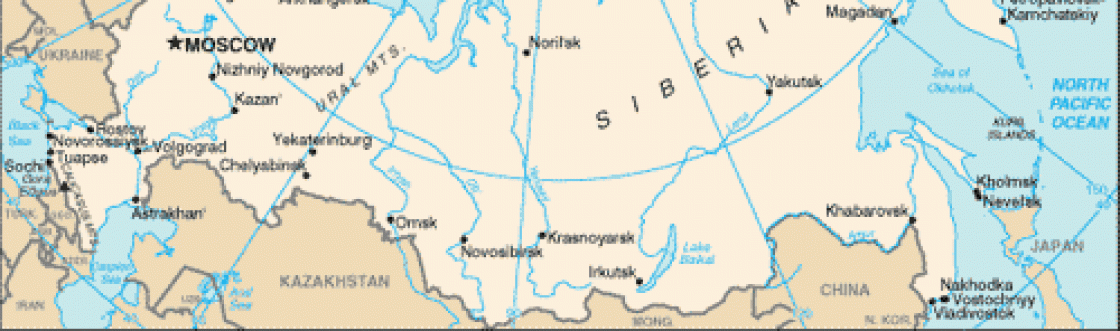
This intentionally-named blog is a space where I explore international politics, economy and security issues, with dashes of culture and historical context. The regional focus of the entries will actually be an amalgamation of regions including but not limited to: the Russian Federation and the former Soviet Union, its borders and its sphere of influence. This will generally cover central Asia, eastern, central and southeastern Europe. I will also occasionally cover parts of the middle east, north Africa, eastern Asia and, of course, Russia itself. These areas and the countries within them fascinate me due to their inherently connective yet contentious nature. These regions all in some way connect cultures and ideologies that at their further reaches can be incredibly juxtaposed, but which meld along these boundaries, often causing conflict within and between borders. The conflicts of these states’ politics, the performance of their economies and their rates of human development differ greatly, and, like all states, have their own histories and particular circumstances from which their present state of affairs came to exist. I want to focus on these states because of their vast complexities, but also their common feature: these regions act as portals through which ideologies flow and exchange, but too often become blockades by which communities build up their battlements of ignorance, regression, self-perceived protection but other-perceived aggression. These areas have been killing fields on which cultures, philosophies and ideologies war. I hope to improve my knowledge of these places and their politics in a way that provokes, inspires and ultimately challenges the way that I and my readers perceives global affairs, hopefully transforming our perceptions into more insightful, dynamic world views.

Connect with me at tracyllyon@gmail.com.